

Deal Alert 

SCD Advisory acted as exclusive sell side advisor to Advancy Australia on its sale to PwC Australia
02nd October 2026 4 min. read

 Our Focus image"/>



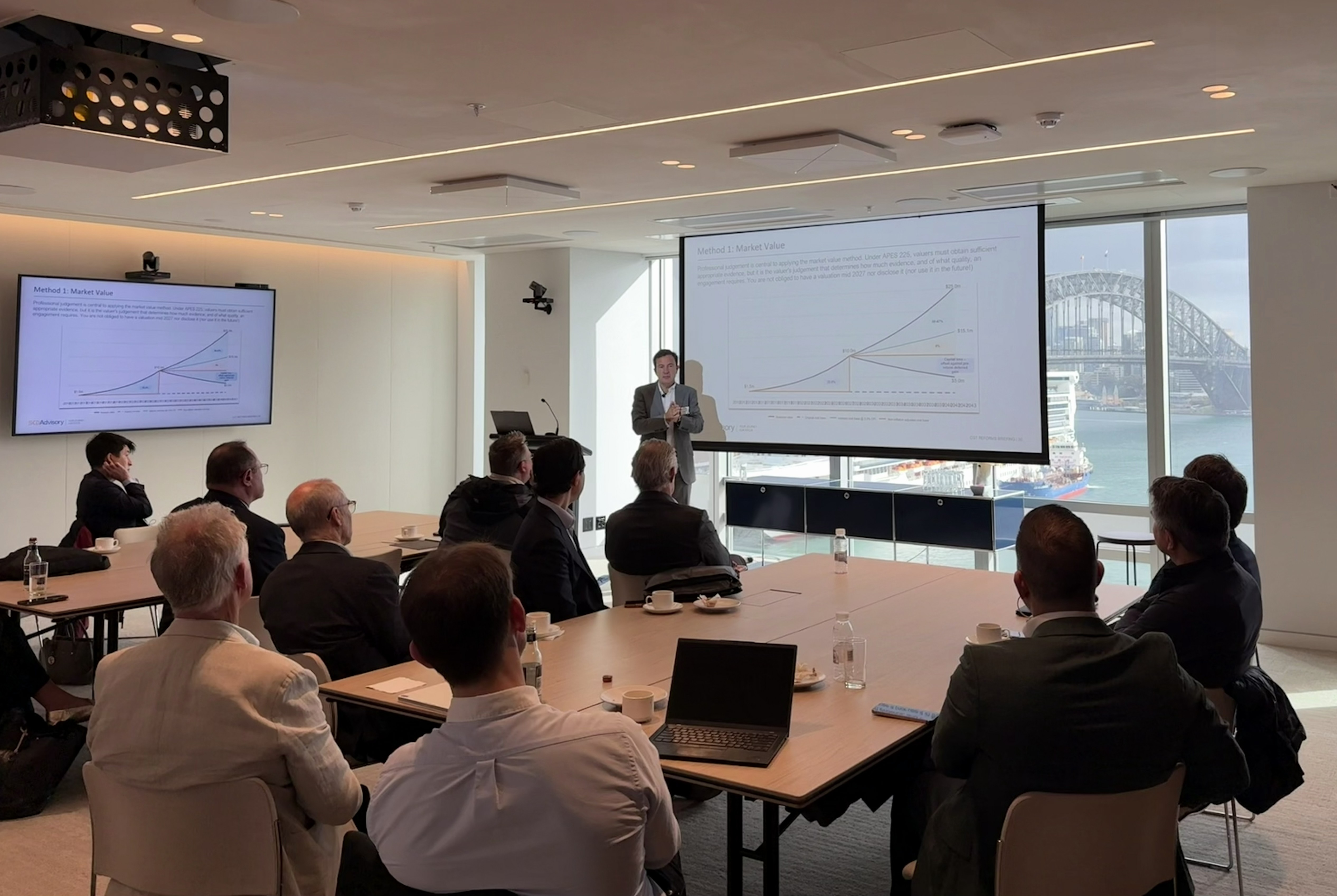
SCD Advisory, together with Maddocks, recently hosted breakfast briefings in Sydney and Melbourne on the CGT reforms and what they mean for a future exit. This article draws on the themes and questions raised by an engaged group already thinking about timing, valuation and structure.
The 2026-27 Federal Budget, handed down on 12 May 2026, set in motion the most material change to Australia’s Capital Gains Tax (CGT) regime since the 50% CGT discount was introduced in 1999. The resulting legislation, the Treasury Laws Amendment (Tax Reform No. 1) Bill 2026, has now passed both Houses of Parliament and remains subject to Royal Assent and the commencement of the related Income Tax Rates Amendment Bill. From 1 July 2027, the 50% CGT discount for individuals, trusts and partnerships will be replaced by cost base indexation, alongside a new 30% minimum tax rate on real capital gains.
For founders, private business owners, investors and acquirers, this is not a peripheral tax adjustment. It changes the after-tax economics of an exit and the calculus around when to transact, and the 1 July 2027 start date is no longer a moving target, it is now the line the market is now planning around. For founder led and high growth private companies, the key issue is not only whether to sell before or after that date, but how much of the value created in the business is treated as having accrued before it, and how much as post 1 July 2027 growth.
Overview of the CGT Reforms
Here’s what changes from 1 July 2027:
The stated policy objective behind all of this is straightforward: tax only the real component of a gain, in a manner conceptually similar to the indexation regime that applied before 1999.
The detail that will matter most in practice is the 30 June 2027 valuation, whichever of the two methods is used, it becomes the reference point that determines how much of a future gain sits under the old rules and how much sits under the new ones. For private business owners in particular, an apportionment formula built around a compounding growth rate may not reflect how value in the business was actually created.
Why the 1 July 2027 Valuation Matters
For many private company shareholders, the 1 July 2027 valuation may become one of the most important tax reference points in any future exit.
If a business is sold after 1 July 2027, the value attributed to it at that date will effectively determine how much of the gain remains subject to the current 50% CGT discount and how much falls into the new indexation regime.
This is relatively straightforward for listed shares, where quoted prices are available. It is much more complex for private companies, where value creation is often non-linear. A founder led business may grow steadily for several years, then experience a step change in earnings, margin or valuation multiple immediately before exit. Equally, a business may invest heavily before 1 July 2027 and only realise the benefit of that investment in the years that follow.
Where the apportionment method is used, there is a risk that the estimated 1 July 2027 value does not reflect the actual value of the business at that date. Where a formal valuation is used instead, the outcome will depend heavily on the quality of the valuation, the available evidence and the assumptions adopted. Notably, business owners are not obliged to obtain a valuation on 1 July 2027, nor to disclose or use one they do obtain.
This creates a practical challenge for founders and investors. Businesses that generate significant value after 1 July 2027 may be taxed less favourably than under the current 50% discount regime, particularly where growth materially exceeds inflation.
The High Growth Private Company Problem
The Government’s published modelling leans on asset classes such as residential property and listed shares. For listed shares, it uses average S&P/ASX 200 capital growth of around 4% per annum.
That may be a reasonable reference point for broad listed market returns, but it is not necessarily representative of high quality private companies. Founder led, private equity backed and fast scaling businesses can grow revenue, earnings and enterprise value at rates materially above 4% per annum, and the gap between how the reform treats a 4% asset and a 20% asset is not small.
Modelling a business growing at 5% a year shows an effective tax rate on post 2027 gains of around 22%, not far off today’s outcome under the 50% discount. At 10% annual growth, the effective rate rises to around 38%. At 20% annual growth, closer to the pace many venture backed and private equity owned businesses actually target, the effective rate reaches around 45%, since indexation at CPI (assumed here at 3%) barely dents a nominal gain compounding at that speed.
This matters because indexation only shelters the inflation component of the gain. Under the current regime, a shareholder can generally disregard 50% of a capital gain after the relevant holding period, regardless of how fast the asset grew. Under the new regime, the taxable gain is reduced by CPI indexation rather than a fixed discount. For assets that grow well above inflation, the new regime can produce a materially higher taxable gain, and the faster the growth, the wider that gap becomes.
In practical terms, the reforms may penalise businesses that generate strong growth after 1 July 2027, at least relative to the current CGT discount. The better the business performs after that date, the more value may be captured under the new regime.
Timing matters as much as growth rate. For a business sold in the first year or two after the reforms commence, the practical impact is likely to be modest, as only a short period of post 1 July 2027 growth sits under the new regime, so the after-tax outcome will not differ markedly from today’s. The larger impact comes later. The further out the exit, the greater the share of total value that has accrued after 1 July 2027, and for a business compounding strongly that share grows quickly. A strongly growing company that exits five or ten years after commencement may find the substantial majority of its gain taxed under indexation and the 30% minimum tax rather than the 50% discount.
This is particularly relevant in the M&A context. Private company exits often involve concentrated value creation in the years immediately before sale. A business may professionalise its management team, expand margins, win major contracts or re-rate its earnings multiple shortly before exit. If that uplift occurs after 1 July 2027, shareholders may face a materially different after-tax outcome.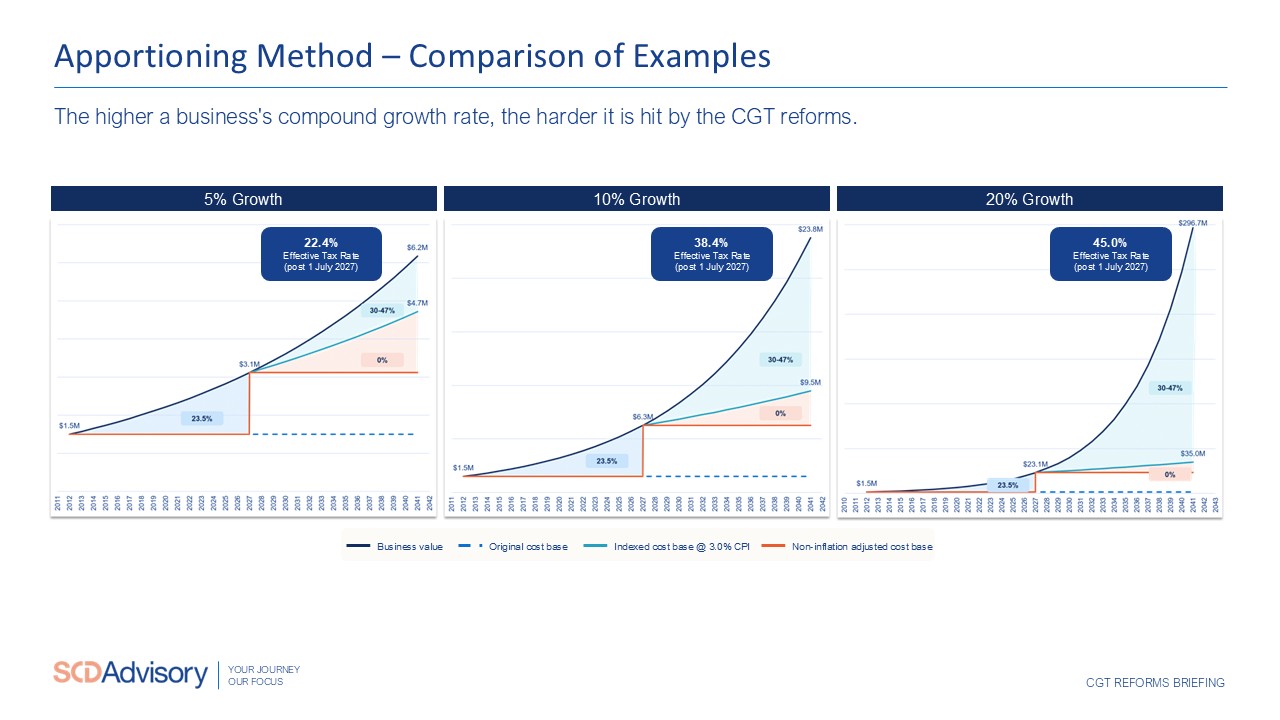
Potential Implications for Business Owners and Investors
Policy design and calibration
Our view is that the measures are workable for passive property assets but poorly calibrated for operating businesses. A reform shaped around real estate is being applied to all asset classes, which creates economic and financial distortions: enterprise values are not linear and typically grow well above CPI when a business performs.
The increase in the small business turnover threshold to $10 million protects genuinely small businesses, but it offers no incentive to scale beyond it and, in combination with the new regime, may weigh on new business formation from 2027.
Valuation mechanics and incentives
Two valuation methodologies running side by side invites disputes: between shareholders, between shareholders and their valuers, and between taxpayers and the ATO. Because a higher 30 June 2027 value shelters more of a future gain under the old rules, there is a clear incentive to obtain and retain an optimistic valuation at that date, with corresponding exposure to conflict and penalties if the position cannot be supported.
Market response
The reforms may accelerate M&A activity through 2027 and 2028 as owners move to lock in the pre-reform 50% discount, even though, as noted above, the reform is close to insensitive for exits in the first years after commencement. Conversely, if valuations fall after 1 July 2027, a 30 June 2027 valuation set at the top of the cycle may leave the measure largely redundant for those shareholders.
Conclusion
The CGT reforms are significant, but the key issue for business owners is not only timing. It is how value is measured and allocated before and after 1 July 2027.
For founder led and high growth private companies, this matters because value creation can exceed broad listed market assumptions and may be concentrated in the years immediately before exit. Where material growth occurs after 1 July 2027, shareholders may face a higher tax burden than under the current 50% CGT discount.
Disclaimer: This article is general commentary based on publicly available information as at the date of publication. It summarises selected aspects of the Treasury Laws Amendment (Tax Reform No. 1) Bill 2026 and the related Income Tax Rates Amendment Bill, which have passed both Houses of Parliament and remain subject to Royal Assent and any subsequent amendment, regulation or legislative instrument. It is not a complete statement of the law and is not tax, legal or financial advice. You should obtain advice specific to your circumstances from a qualified adviser before acting on anything in this article.
About SCD Advisory
SCD Advisory is an independent Australian corporate advisory boutique, dedicated to the B2B Services sectors – from IT and digital engineering to marketing and consulting – to help sharpen the growth narrative, present the right metrics, and position for successful M&A outcomes.
If you’re starting to think about a transaction, it’s never too early to start shaping the story. We offer a range of services from deal preparation to transaction execution. Contact us at info@scdadvisory.com to find out more.

Pierre brings 25 years of expertise in advising entrepreneurs, with a deep background in management and financial advisory across corporate finance, private banking, and wealth management. His extensive experience includes numerous sell-side and buy-side deals, IPOs, mergers, integrations, and consulting projects for both small businesses and large global corporations. As an established and highly regarded advisor, Pierre is known for his savvy, trusted guidance.
Pierre’s career began in Australia before he moved to France, where he worked with prominent business figures like billionaire François Pinault on M&A deals within the Artemis group. He then founded BC&D, an M&A small-cap firm in Paris, where he managed corporate advisory services across Europe, covering both origination and execution. His work extended beyond transactions, advising entrepreneurs on wealth management strategies to optimise the transition from business ownership.
In Paris, he held advisory roles at the Belgium Family Office (DeGroof) and as a senior private banker and head of the HNW segment for France at JP Morgan. Returning to Australia in 2015, Pierre established the ANZ subsidiary of a UK-headquartered M&A firm, executing 9 M&A transactions across Australia. In 2019, he launched SCD Advisory, where he has since completed 35+ transactions, earning multiple global awards in M&A advisory from 2021 to 2024. Notably, he was named ‘Deal Maker of the Year’ by Finance Monthly in 2022 for his sale of Hypothesis to McKinsey & Co.
Pierre graduated from the Business of Troyes in France and has a postgraduate in Corporate Finance from the University of Caen. He is also a certified Financial Analyst and a Graduate of the Australian Institute of Company Directors (GAICD). Pierre further enhanced his credentials by completing the “Leading Professional Services Firms” program at Harvard Business School. His track record and accolades highlight his dedication to excellence and his exceptional skill in delivering successful outcomes for his clients.
Pierre is French, Australian citizen, Overseas Citizen of India. He is married and has two children. He is passionate about international travel, gastronomy, sailing and golf. As an experienced sailor, his motto in business and life in general is: “We cannot direct the wind, but we can trim the sails”






Give us a call on +61 434 730 099. Or, email us at info@scdadvisory.com
or fill in our contact form and we will give you a call.